Saturday, August 31, 2013

Former German Ambassador: Kerry testing the case remembers Iraq

Authorship tests Syrian government of a nerve gas attack mentioned by the United States reminds the case of Iraq, said a former German ambassador to the UN. "There has been no evidence presented. Said there are only convincing evidence (...) But we do not know," he told the station Deutschland funk Gunther Pleuger, who led the German delegation to the United Nations between 2002 and 2006.


The U.S. secretary of state, John Kerry, said Friday that Washington had clear evidence that the government of Bashar al Assad was behind the nerve gas attack on 21 August, which, according to their data, cost the lives of 1,429 people in outside Damascus. "Naturally this reminds Iraq, where they presented alleged evidence and none were true," he said Pleuger.

In 2003, the United States justified the decision to invade Iraq, arguing that Saddam Hussein was developing a program for weapons of mass destruction which provided "irrefutable evidence" that later proved false. Pleuger said the United States should await the results of the inspection of UN experts.


By contrast, the German Foreign Minister, Guido Westerwelle, described as "plausible" Kerry's arguments. "They point clearly to the Assad regime.'re Plausible. Everyone should take it seriously," he told the Sunday "Welt am Sonntag".

Merkel urges more financial market reforms

German Chancellor Angela Merkel urged on the eve of the summit of the Group of 20 to continue reforming financial markets. Merkel said that there is still progress in the field shadow banking sector and hedge funds (hedge funds). "I want to agree on a binding timetable to make it clear when to take what steps," he said in his weekly Internet video.


The Group of Twenty agreed that each financial actor, every financial product and every financial market should be regulated, Merkel reminded, for whom the balance so far is "light and shadow". The heads of state and government of the G20 industrialized countries and emerging powers-will meets on Thursday and Friday next week in St. Petersburg to celebrate its eighth summit.


One of the issues that will dominate the meetings on the sidelines of the meeting is the possibility of military action against the regime of Bashar al Assad in Syria. Merkel also expected advances in the field of tax evasion. "The greatest economic power nations agree to an automatic exchange of information", she said. He said the G20 would probably adopt the recommendations of the Organization of Economic Cooperation and Development (OECD) to prevent multinationals to evade taxes.

Cameron: 'unthinkable' attack Syria with "overwhelming opposition"

 The attack seemed imminent against Syrian territory seems to go dilating, after British opposition questioned the relevance and strength of the evidence used to justify intervention and remember the experience with Iraq, involving the country in a conflict whose consequences are experienced until today. This Thursday (29/08/2013), Prime Minister David Cameron spoke before the House of Commons the government's position on the conflict, but qualified and said it would be "unthinkable" to take military action against Syria if there was an "overwhelming opposition" in the Security Council of the UN, but in his opinion a "humanitarian intervention" would be legal, but does not count with the approval of the UN.


Also, Cameron said it was "highly likely", according to the intelligence, that the regime of Bashar al Assad had used chemical gas attack, according to some sources, killing at least 300 deaths last 21 August in the outskirts of Damascus. "It is not taking a position on the conflict, not to invade, or regime change," but to "respond to a war crime," said Cameron. But he acknowledged that there was not enough evidence. "National Security" The prime minister said that this "is not like Iraq," adding that it was necessary to learn "what went wrong" then. Meanwhile, Labour leader Ed Miliband called for evidence before decisions "and not vice versa", did not rule out that his party would support the government.

According to a government report, a military intervention is justified only if there was "convincing evidence, accepted by the international community, humanitarian danger scale end." Meanwhile, France and Germany called for UN inspectors found in Syria to give his report on what field collected shortly before the Security Council, to make it possible to take a decision as soon as possible to "meet its responsibility for this monstrous crime." While Denmark said he would support an attack politically, Italy distanced itself ensuring that it will not join if you do not have the authorization of the Security Council.


Egypt, meanwhile, do not support in any case. On Wednesday night, meanwhile, the U.S. president, Barrack Obama attempted to convince Americans saying the Syrian intervention was related to national security. "If we say in a clear and decisive but very limited 'stop doing this', that can have a positive impact on our national security long term," he said in a televised interview. And on Thursday, the White House said any response would be limited, rejecting comparisons with the U.S. led war in Iraq.

Does he break the "no" British "Alliance of the Willing"?

 The idea was to form a large "Alliance of the willing" to punish crimes against humanity committed by the Syrian regime of Bashar al Assad and his troops. As in 2003, when 50 nations came together to topple Saddam Hussein. But precisely Prime Minister Cameron, who on behalf of Britain said early be prepared to militarily attack Syria, even without UN permission, lost - although narrowly - a vote of confidence in Parliament . "An unexpected event" for Kai Oppermann German political scientist at King's College, London. "The prime minister review misjudged the action both within their ranks and in the population," says Oppermann, who concludes that "the vast majority of Britons do not want their country to participate in military strikes against Syria".


Reply lasts without pumps: German strategy with Syria

Also I see the professor at the University of Erlangen, Roland Sturm, who does see that it was the widespread rejection of the population to military action which prompted MPs to vote against Cameron's plans: "In Britain, politicians may contradict much to their constituents if they want to be elected again.”

British-American Relations rasponeadas

For Professor Sturm, vote against Cameron has a strong internal connotation, since most of the British argue that "it is obvious that Britain is next to the United States, as well as that London should have a place among the powers." According to Sturm, "the British support an alliance against evil, but you see the national political sense".

But the "special relationship" between London and Washington going wrong for some time. Already in 2003, Tony Blair was branded as "Bush's poodle". This just adds that "the confidence they need partners in disputes with third parties has been undermined by the Parliament itself," says Oppermann. A serious matter, since Britain was that U.S. stocks pushed against Syria. Now will be the British who decide what will be your role in the world. There will be internal consequences and Cameron already shaking.

Obama: The new shooter?

The loss of support from Britain leaves Obama alone in the field, while the French newspaper "L'Alsace" is presented as one of those cavalry commanders who gives the order to fire and runs off. Obama has hinted that he would attack Syria, even without a UN mandate.

Shortly international support for attacks

"If the Security Council is unable to act, it will form a coalition," he said, for his part, François Hollande. Germany, however, is cautious. Merkel has said that the authorship of the chemical gas attacks has already been tested. But Germany did not take part in military attacks, especially without UN authorization. Poland has a similar stance. Turkey for its part, believes that an attack on Assad accelerate its fall. Although fears of retaliation are great, since both countries share 800 km of border. Israel also supports a military operation, but refrains from participating in it for fear of retaliation.

Friday, August 30, 2013

A prize for Edward Snowden

 The Association of German Scientists (VDW), the International Association of Lawyers against Nuclear Arms (IALANA) and Transparency International to U.S. informant reward for his revelations about the spying program PRISM. "Snowden revealed illegal practices data control, which had a considerable impact on international relations between the U.S. and Europe. Also acted without interest and risked a long prison sentence, "the jury justified its decision.


Snowden, who was granted temporary asylum in Russia, could not come to Berlin at the award ceremony this August 30. Traveling to Germany was at risk of being arrested and extradited to the U.S. Otto Jackal, IALANA president, and notes that it is not the first time it happens that: in 1999, Jackal had to travel to Russia to give the award to Alexander Nikitin. Navy captain had to appear before a Russian court for his revelations on accidents in nuclear-powered ships and dumping of nuclear waste in the Boreal Ocean and was not allowed to travel to Germany. However, the award had a positive effect: "The award and public attention that caused his delivery made Russian courts acquit Nikitin," says Jackal.

Symbolic prize large effects

 Whistle blower Award 2011 for disclosing safety deficiencies in nuclear reactors. Whistle blower Award 2011 for disclosing safety deficiencies in nuclear reactors. Prize Whistle blower is equipped 3,000. It seems little, but according Jackal, it shows the true virtue of whistle blowers who "act without self-interest, by conviction, not the prize."

On the contrary, they often pay a heavy price. Rainer Moor man, for example: Chemical Nuclear Research Center Julich received the award in 2011. In 2009, security expert revealed that the modular reactor technology pebble bed was not as safe as it is generally said. Thus, a transaction prevented 1,500 million Euros between Germany and South Africa.

Since then, his boss and many colleagues considered him a traitor. "I marginalized and lost a lot of contacts," says Mormon. "But I felt no hatred or anger, but the desire to fight the intrigues and lies of my opponents and stick to my principles," he adds. Prize Whistle blower was a late apology: "I gave a lot of contacts and invitations to conferences and allowed me to continue to represent my position in Germany," says Mormon.
 Otto Jackal: We want to show that they are not alone. Otto Jackal: "We want to show that they are not alone. At the same time, for much recognition is awarded as a signal observed Jackal juror: "It shows them that they are not alone, that there are people who appreciate what they did. They also said prospects for life after whistle blowing."

A political statement

The topics covered by the winner’s whistle blowers are always politically explosive. Therefore, the prize always carries a political message. In Germany there is still a "culture of whistle blowing ". Therefore, Rainer Mormon great hopes in the Prize Whistle blower: "Note that in Germany, unlike the Anglo-Saxon area, the whistle blowing is rather considered a disgrace.”According to the 2011 winner, reasonable legal rules are needed about in the country. "To those who would like to give the award one day and there was no need to grant it," says Otto Jackal. However, a mere change in the law does not entail that: "Even if there are protection regulations, I think there will continue actions whistleblowers worthy of an award.” 

Thursday, August 29, 2013

Anticorruption campaign with ulterior motives:Venezuela

The United Socialist Party of Venezuela (PSUV) and its political adversaries gathered at the Democratic Unity Table (MUD), are far from overcoming the mutual distrust that has made it virtually impossible for a reasoned debate on the most pressing problems of the country and its viable solutions. That has again become clear since last August 12, when Nicolas Maduro-successor to the late Hugo Chavez as president, announced that he would declare war on corruption at the national, regional and municipal levels.
Maduro said that would require approval of a law enabling the National Assembly to grant him special powers to curb phenomena such as embezzlement and illicit enrichment in the field of state administration and other crimes against the public treasury. But considering that about fifty low-ranking officials have been arrested since late July for committing such offenses, the question arises whether the existing anti-corruption laws are not sufficient to meet this challenge.
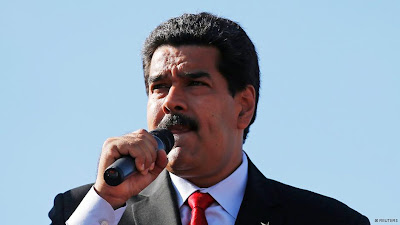


"Populist campaigns of this style are typical of leaders as the current president of Venezuela, Nicolas Maduro. He's not a career politician. In fact, like Chavez, Maduro never tires of repeating that he does not belong to the political elite bureaucracy or traditional country. And, like other anti-politicians in the past, now Maduro suggests that it is precisely what enables him to combat administrative corruption prevailing "criticizes Claudia Zilla, a researcher at the Foundation for Science and Politics (SWP) in Berlin.
 Former Venezuelan President Hugo Chavez (1999-2013) ruled by decree on several occasions. Former Venezuelan President Hugo Chavez (1999-2013) ruled by decree on several occasions.

Special powers against abuse of power

"What Maduro is saying is, 'corruption thrives in politics and public administration, and only someone who comes from outside, like me, can fight corruption without compromise'. But he seems to ignore the paradox implicit in the act of demanding special powers to end corruption. Venezuela does not need new enabling legislation to facilitate arbitrary decisions and abuse of power, but on the contrary, "said the specialist.
"A urges Venezuela to monitor compliance with the laws that already exist to control those who have the power in their hands. Because what we call corruption is nothing but abuse of power. And there are good reasons for Parliament and the Executive Justice-not-who have the power to investigate and punish acts of corruption. The last institution from which one would expect a 'fight against corruption' is the Executive "emphasizes Zilla.

"The government and his cabinet are in constant exercise of power. In other words, the executive is not the body that must be controlled, but must be controlled because it is the most likely to fall into the temptation to abuse their power. Sure there may be corruption in Parliament, as has been seen in Brazil, but if that's the case, then it is important to have independent institutions: one solid and Justice Ombudsman credible, "adds the expert of the SWP.  Henrique Capriles, former presidential candidate and leader of the Venezuelan opposition. Henrique Capriles, former presidential candidate and leader of the Venezuelan opposition.

Calculation? Pre-election?

"Adopt an enabling law for a president fight corruption is like taking a remedy knowing that it will be worse than the disease. This measure goes against the logic of control and limitation of power, which is what actually reduces the sources of corruption. Furthermore, it is contradictory, to say the least, that a party of government wants to start a campaign against corruption after devoting to erode the separation of powers and ensure its hegemony in Parliament, "says Zilla.

In Venezuela it is feared that Maduro proceed with Chavez, who ruled by decree on several occasions and enacted laws were not always relevant to the purposes for which they had asked to be granted special powers. A MUD not reassured by the fact that, at this moment, does not enjoy the support Maduro parliamentary enjoyed in life "Commander": to give the green light to an enabling law, Mature needs 99 lawmakers-three-fifths of Parliament - the approval. Currently, the PSUV has 98 assembly members only.
The former presidential candidate and opposition leader Henrique Capriles, has spoken openly about the risk that a change MUD deputy main and, once enacted, the enabling law is used to imprison him and outlaw his party, Primero Justicia, before the holding of municipal elections, scheduled for December 8. So far, two members of PJ and an official of the government of Miranda near Capriles have been accused of corruption, but the charges could start raining on prominent figures.

A play "business"

Although the administration of justice in the South American country still leaves much to be desired, Chávez promised "tough" and proposed to increase penalties for corruption of five or ten to thirty years in prison. Nikolaus Werz, Venezuelan happen connoisseur and expert in comparative politics at the University of Rostock, describes as "skilled" Maduro's decision to set a north to his presidency. And, so far, his government program lacked a recognizable address.

"Venezuela's economic situation is not good, but that's just one of the many troubles that the country has. What Maduro is doing is to choose one of the issues of greatest concern to the population, administrative corruption is second in importance, according to some polls, and try to convince the public that need special powers to solve. That puts the Venezuelan opposition under pressure because who will demonstrate against the fight against corruption? "Said Werz. 

"However, it can be assumed that Maduro has ulterior motives when he asks for approval of an enabling law to provide these special powers. Whereas Chavez were in leadership positions who had been the subject of allegations of corruption, it is paradoxical to some extent, that the PSUV is now the flagship of a crusade against this scourge and to put on the look to public servants engaged in opposition, "says the professor of Rostock.


If Maduro she receives special powers to combat corruption, can the PSUV end up being a victim of his own campaign? Werz does not. In their eyes, the Venezuelan ruling could emerge unscathed from the investigations. "Chavista leader’s blindarían successfully against charges. As example will suffice: the official who acts more illegal enrichment is attributed strongman Chavez second and never tested anything against him, "said the expert, referring to the president of the National Assembly Diosdado Cabello.

Syria: differences in opposition to international intervention

National Coalition for Syria, which groups opposition forces, the authorship of the poison gas attacks on Wednesday August 21, 2013 is clear. The Assad regime is responsible, said the opposition group the same day of the attack, appealing to the international community intervention: "We urge the Security Council to try crimes of Assad and publish a resolution to ensure the maintenance of peace and security ".


As a basis for their claims, the National Coalition alludes to numerous witness statements confirming the responsibility of the Assad regime. Political signs also point to his trial in that direction. "There are very suspicious of the opposition to think that they would kill those who support and help," says Sadiq Al-Mousllie, spokesman for the Syrian National Council in Germany, an organization belonging to the National Coalition. While acknowledging the existence of extremist groups mixed with the opposition, Al-Mousllie looks unlikely to have been the last the authors: "If they had they would face a tough reaction from the real opposition Syria. The Syrian Liberation Army would not accept, "he says.

The National Coalition ambassador in France, Monzer Makhous, agrees appeal to the international community: "Western countries as defenders of human rights and freedom, could punish the Assad regime and environment for the massacres and attacks chemical weapons, "said Makhous in conversation with DW, adding that this could be done" for example through military action."

Expectations opposition

Such intervention is facing many obstacles yet diplomatic. Neither China nor Russia would accept UN resolution to that effect, said Monzer Makhous. But, in view of the chemical attacks, believes the action against the regime would be legitimate even without a UN resolution, "United Nations recognizes the principle of protection. This requires international actors to intervene in cases of gross violations of human rights by a government. "

Furthermore, in the current scenario, a military intervention could also be strategically appropriate for the National Coalition. As his spokesman Hisham says Marwah, the arming of the regime is clearly superior, especially with weapons from Russia and Iran. The opposition does not have a similar support.

Intervention risk

But not all opposition groups supporting military intervention. The Syrian National Committee for the Coordination of the Transition to Democracy manifests categorically against. His spokesman, Haythan Manna, told United Press that chemical weapons came from local manufacturers. At the same time, the group criticized focus attention only on victims of chemical attack while in Syria and 100,000 people have died.


What is clear is that military intervention would be risky. The newspaper "Al Hayat" said that, in case of attack, Damascus could launch missiles into Israel, causing that country reacts. At the same time, the Assad regime could shoot neighboring Jordan and Turkey (NATO member). Neither could anticipate the reaction of Iran, an ally of Assad, Hezbollah or Israel. Also jeopardized the UN troops in southern Lebanon. Like the daily Al-Sadiq also sees the risks Mousslie entail military action. "But if we wait, there will be risks," the spokesman concluded.